


Vad orsakar bubblor i ett swim spa-bubbelbad?
2025-12-08 15:35Detta bevarar den massageliknande komforten som bubblorna ger samtidigt som det förhindrar skumbildning eller grumlighet.
Varför uppstår det många bubblor i swim spa-jacuzzin efter att man har tillsatt nytt vatten?Nytillsatt kranvatten innehåller vanligtvis lösta gaser som kväve, syre och koldioxid. Dessa gaser frigörs och bildar bubblor när de upphettas eller omrörs.Dessutom kan tillfällig skumbildning uppstå när nytt vatten kommer i kontakt med kvarvarande kemikalier från det gamla systemet.
Lösningar:
• Kör systemet i några timmar så att gaserna kan avledas naturligt;
• Tillsätt inte desinfektionsmedel omedelbart; vänta tills bubblorna försvinner innan du justerar vattenkvaliteten;
• Om skummet kvarstår i mer än 24 timmar bör vattnets sammansättning testas.
Vilka blir konsekvenserna av att ignorera onormala bubblor?
Att ignorera bubbelproblem kan leda till följande konsekvenser:
• Minskad effektivitet i filtreringssystemet: Skum täpper till filterpatronerna, vilket minskar vattenflödet.
• Försämrad vattenkvalitet: Bubblor bär med sig föroreningar, vilket ökar risken för bakterietillväxt.
• Minskad värmeeffektivitet: Bubblornas isolerande effekt orsakar ojämn vattentemperatur och energislöseri.
• Ökat slitage på utrustningen: Luft som kommer in i pumpsystemet orsakar tomgång, buller och slitage.
Därför är underhåll och övervakning av bubblor en viktig underhållsmetod för att förlänga livslängden på ett swim spa-bubbelbad.
Vad orsakar bubblor i ett swim spa-bubbelbad?
Orsakerna till bubblor i ett swim spa-jacuzzi kan sammanfattas enligt följande:
• Mekaniska orsaker: luftinsprutningssystem, vattenpumpsinsug, vattenturbulens och temperaturförändringar;
• Kemiska orsaker: tvättmedelsrester, obalans i vattenkvaliteten, för mycket desinfektionsmedel och ansamling av organiskt material;
• Utrustningsproblem: dålig tätning, igensatta filter eller onormala luftkanaler.
Vanliga bubblor är en del av spa-upplevelsen, men om det finns för många bubblor, ihållande skum eller grumligt vatten är snabb inspektion och underhåll nödvändigt.
High-speed jets of water, upon contact with air, produce foamy bubbles. This is especially true in swimming mode, where the strong water flow can entrain air into the water.
4) Gas Release Due to Temperature Changes
As the water temperature rises, dissolved air in the water is released, forming tiny bubbles. These bubbles are particularly common during the heating process.
2. Chemical Bubbles
Chemical bubbles originate from chemical reactions in the water, such as:
1) Detergent or Bath Product Residue
Using shampoos, shower gels, or cleaning solutions containing foaming agents can create numerous persistent foam bubbles on the water surface, affecting the filtration system.
2) Water Hardness or Disinfectant Reactions
High concentrations of calcium, magnesium, or chlorine in the water can cause chemical reactions that lead to bubble formation. Excessive use of chlorine- or bromine-based disinfectants can cause foamy bubbles to accumulate.
3) Organic Matter Accumulation
Organic matter in skin oils, cosmetics, or sweat can react with chemicals in the water, potentially producing bubbles or a foam layer.
Therefore, correctly identifying the type and source of bubbles is crucial for determining if the swim spa hot tub is functioning properly.
Are the Bubbles in a Swim Spa Hot Tub Good or Bad?
Normal Bubbles: Part of the Spa Function
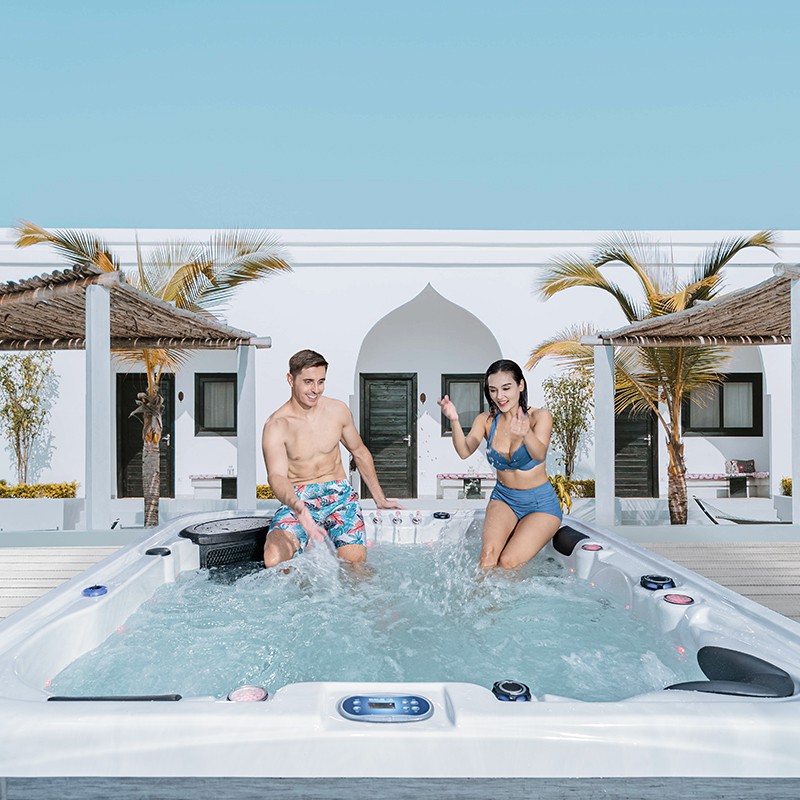
When you activate the bubble massage mode on your swim spa hot tub, the system actively injects air. These bubbles are evenly distributed, continuous, and gentle, providing a pleasant spa experience. They are healthy and safe bubbles.
Characteristics of these bubbles:
• Fine foam that rises quickly;
• Clear water surface with no noticeable foam layer residue;
• No accompanying odor or turbidity.
Abnormal Bubbles: A Signal of Potential Problems
If the bubbles are abnormally dense, persistent, or even accompanied by a foam layer or odor, it indicates an abnormality in the system or water quality. Possible problems include:
• Contaminated filtration system;
• Disinfectant concentration too high or imbalanced ratio;
• Air entering the pump system;
• Improper water quality maintenance or accumulation of organic matter.
Therefore, judging the "quality" of bubbles requires analyzing their source, morphology, and duration.
Can the pump system cause abnormal bubbles?
Yes, the pump's operating status is directly related to the number and morphology of bubbles.
1. Pump Intake of Air
If the pump seals are aged or the inlet is not fully submerged in water, air can be drawn into the water flow. In this case, the spa nozzle will spray out large bubbles mixed with air.
2. Clogged Filter System
When the filter is clogged, the pump pressure becomes unstable, causing air to get into the water flow. Cleaning or replacing the filter usually improves the bubbling situation.
3. Loose or Cracked Connections
Small leaks at pipe connections can draw air into the system, forming bubbles. Checking and resealing these connections can effectively reduce abnormal bubbles.
Therefore, regularly checking the pump system and filter is a crucial step in preventing abnormal bubbles in swim spa hot tubs.
Can Water Quality Issues Cause Bubbling?
1. Excessive Disinfectant
Using excessive chlorine or bromine disinfectants lowers the surface tension of water, making bubbles less likely to break, thus forming a persistent foam layer.
2. pH Imbalance
When the pH of the water is too high (>7.8), bubbles are more likely to form and persist. The pH should be maintained between 7.2 and 7.6 using test strips or an automatic pH meter.
3. Organic Matter Accumulation
If the water contains excessive human secretions or foreign substances, the bubbles will be more stable. Regularly changing part of the water and using an antifoaming agent can effectively alleviate this problem.
4. Excessively High Water Temperature
High temperatures cause dissolved gases to be released, thus increasing the number of bubbles. Therefore, when heating to above 38°C, pay attention to whether excessive bubbles appear.
What to do if there are too many bubbles in a swim spa hot tub?
When you find that the foam on the water surface is too thick or lasts for too long, you can check and solve the problem by following these steps:
1. Check water quality parameters
Check indicators such as pH, chlorine, and alkalinity to ensure they are within the reasonable range.
2. Clean the filtration system
Use a special cleaner or warm water to clean the filter to remove grease and impurities.
3. Reduce the amount of chemicals used
Do not arbitrarily add multiple disinfectants or water balancers.
4. Use an antifoaming agent
If the foam is temporary, a low-foaming antifoaming solution can be used, but do not use excessive amounts.
5. Replace Part of the Water
If the foam is difficult to eliminate, drain some of the old water and add fresh water to maintain water quality.
6. Check the Air System's Tightness
Confirm that all joints and air hoses are free of cracks or looseness to prevent air leakage.
Using the above methods, the normal water quality of the swim spa hot tub can usually be restored in a short time.
Can bubbles be completely avoided?
Completely eliminating bubbles is impossible, as bubbles are part of the working principle of the swim spa hot tub. However, they can be kept within a healthy and controllable range through proper management.
Recommended measures include:
• Maintaining water balance (pH 7.2–7.6, chlorine 1–3 ppm);
• Cleaning the filtration system weekly;
• Using non-foaming cleaning products;
• Regularly checking the air blower and pipe tightness;
• Controlling the water temperature to avoid overheating.
This will preserve the massage-like comfort provided by the bubbles while preventing foam buildup or cloudiness.
Why do a lot of bubbles appear in the swim spa hot tub after adding new water?
Newly added tap water typically contains dissolved gases such as nitrogen, oxygen, and carbon dioxide. These gases are released and form bubbles when heated or agitated.
Additionally, temporary foaming can also occur when new water comes into contact with residual chemicals from the old system.
Solutions:
• Run the system for a few hours to allow the gases to dissipate naturally;
• Do not add disinfectant immediately; wait for the bubbles to disappear before adjusting the water quality;
• If foam persists for more than 24 hours, the water composition should be tested.
What are the consequences of ignoring abnormal bubbles?
Ignoring bubble problems can lead to the following consequences:
• Reduced filtration system efficiency: Foam clogs filter cartridges, reducing water flow.
• Water quality deterioration: Bubbles carry impurities, increasing the risk of bacterial growth.
• Decreased heating efficiency: The insulating effect of bubbles causes uneven water temperature and energy waste.
• Increased equipment wear: Air entering the pump system causes idling, noise, and wear.
Therefore, maintaining and monitoring bubbles is an important maintenance method for extending the life of a swim spa hot tub.
What causes bubbles in a swim spa hot tub?
The causes of bubbles in a swim spa hot tub can be summarized as follows:
• Mechanical causes: air injection system, water pump suction, water turbulence, and temperature changes;
• Chemical causes: detergent residue, water quality imbalance, excessive disinfectant, and organic matter buildup;
• Equipment problems: poor sealing, clogged filters, or abnormal air passages.
Normal bubbles are part of the spa experience, but if there are too many bubbles, persistent foam, or cloudy water, timely inspection and maintenance are necessary.